
Resources
Topics
- How to Read a Generic AOD Pump Curve
- How to Read a Centrifugal Pump Curve
- Common Pump Terminology
- Chemical Resistance Chart
- EHEDG-Certified FAQ
How to Read a Generic AOD Pump Curve
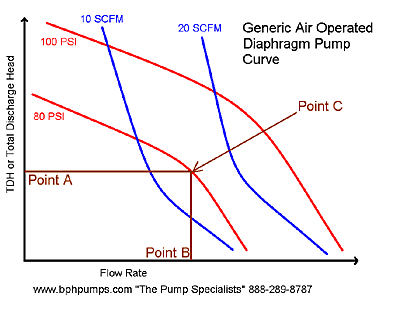
Step One: Identify your required TDH and flow rate
Total Discharge Head (TDH) is the energy required by your fluid to make it through all the constrictions, bends, and appliances plus your required pressure on the outlet side. Flow Rate is your required flux of material. In the sample application above, TDH is Point A; flow rate is Point B.
The BPH team can help you calculate TDH and flow rate. These values are critical in choosing the best pump for your application.
Step Two: Determine air pressure requirements
AOD pumps run faster with more air pressure. In the sample application, you'll be running at 80 PSI. Point C, the intersection of your required TDH and flow rate lies on the 80 PSI flow curve. Please note that your required air pressure will, in most cases, be higher than your TDH requirement.
Step Three: Determine your SCFM requirement and ensure your air compressor is adequately sized
More flow and TDH requires more air. As you go to the right in a flow curve, the amount of compressed air required increases. In the sample application, just less than 15 SCFM is required, (Point C).
Your air compressor is the driving force behind your pump. It provides air pressure and a flow to make your pump work at a given pressure. The table below gives the power per SFCM for rotary compressors.
| Air Supply pressure (PSI) | Horsepower Per SCFM (Rotary Air Compressor in good condition) |
|---|---|
| 20 | 0.071 |
| 25 | 0.085 |
| 30 | 0.096 |
| 35 | 0.108 |
| 40 | 0.118 |
| 45 | 0.127 |
| 50 | 0.136 |
| 55 | 0.145 |
| 60 | 0.153 |
| 65 | 0.161 |
| 70 | 0.168 |
| 75 | 0.175 |
| 80 | 0.182 |
| 85 | 0.189 |
| 90 | 0.195 |
| 95 | 0.201 |
| 100 | 0.207 |
In the example, you're running at 80 psi, so will need 0.182 HP/SCFM. The air consumption is just less than 15 SCFM. You'll need a compressor of at least 2.73 HP (0.182 HP/SCFM * 15 SCFM = 2.73 HP).
How to Read a Centrifugal Pump Curve
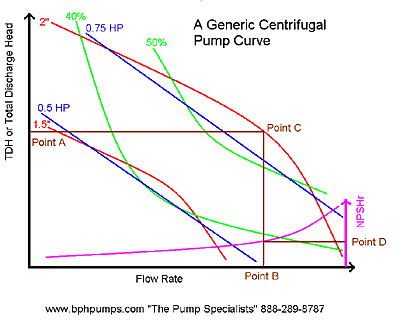
Step One: Know and identify your required TDH and flow rate
Total Discharge Head (TDH) is the energy required by your fluid to make it through all the constrictions, bends, and appliances plus your required pressure on the outlet side. Flow Rate is your required flux of material. In the sample application above, TDH is Point A; flow rate is Point B.
The BPH team can help you calculate TDH and flow rate. These values are critical in choosing the best pump for your application.
Step Two: Select the proper impeller diameter
This refers to choosing the proper flow curve for your requirements. In the sample application shown above, TDH and flow rate intersect at Point C, indicating that a 2” impeller is the correct diameter
Step Three: Size your motor
For any given (and maintained) TDH, the power the required horsepower increases. This is because you are looking at the curve. As you follow the curve your BHP may decrease if the TDH drops off quickly. In the sample application, a 1 HP motor is recommended, since Point C is to the right of the 0.75 HP curve.
Step Four: Consider your efficiency requirements
Each centrifugal pump curve has a set of gradients for efficiency. For most pumps, the best efficiency lies about 2/3 down the right side of a curve. The greater the efficiency, the more power is converted into flow and pressure. In the sample application, Point C indicates efficiency greater than 50%.
If several pumps appear to meet your requirements, consider how much power is needed to move your product. The BPH team can help you choose a pump with the greatest efficiency in order to keep your long-term power consumption costs down.
Step Five: Make sure you have enough NPSH
Rule of thumb: If you have a flooded inlet and low temperature on a non-volatile fluid, you'll have adequate NPSH the vast majority of the time.
Fluid must move freely into your pump at your required flow rate, without help from your pump. Expressed mathematically, NPSHa must be > NPSHr, where NPSHa is net positive suction head available and NPSHr is net positive suction head required. NPSH is typically expressed in units of feet of head. Running a pump with inadequate NPSH is not a good idea. The pump will cavitate and which will cause severe wear on the impeller and seal.
In the sample application, the NPSHr required is found at Point D.
Common Pump Terminology
The purpose of this area is to give you a reference for some of the terms used by pump users and manufacturers. If you don't see something you think needs to be defined, call us at 888-289-8787 or drop us a note on the "Contact us" page.
| Term | Definition |
|---|---|
| Air Consumption | The flow rate of air that is required by an AOD pump or air motor. |
| Air Pressure | Air-Operated Diaphragm (AOD) pumps use compressed air as a power source. Required air pressure is a component of the flow curve. |
| AOD | Air Operated Diaphragm Pump. |
| Cavitation | Cavitation occurs when a localized region of pressure is below the vapor pressure of your process fluid. Your process fluid literally boils forming bubbles and those bubbles quickly collapse-causing damage to pump internals. Cavitation is not a problem as long as you have adequate NPSHa. |
| Flow Rate | Volume of material per unit time. This is usually expressed in units of volume per time (e.g. gallons per minute or GPM). |
| Head | The pressure in a column of liquid. Pressure will increase as the height of the column increases. Head refers to the height in feet; pressure refers to the psi (pressure pounds per square inch). |
| NPSHa | Net Positive Suction Head Available. The head that your system has available is a available on the fluid prior to entering the pump. This is a function of the conditions in a particular installation and is expressed in absolute units. Call us at 888-289-8787 for assistance. |
| NPSHr | Net Positive Suction Head Required. The head that the pump requires on the inlet side to operate properly and is a function of the pump and the position on its flow curve. |
| PSI | Pounds (force) per square inch. A common unit of pressure. |
| SCFM | Standard cubic feet per minute. A common unit of air flow. |
| TDH | Total Discharge Head. This is the required discharge pressure plus friction losses from bends, constrictions and appliances on both sides of your pumping system. |
Chemical Resistance Chart
The information in this chart was supplied to BPH Pump & Equipment by other reputable sources and is to be used ONLY as a guide in selecting equipment for chemical compatibility testing. Always test the equipment with the specific chemicals and under the specific conditions of your application.
Ratings of chemicals listed in this chart apply to a 48-hour exposure period. BPH Pump & Equipment does not warrant (neither expressed nor implied) the accuracy or completeness of this chart or that any material is suitable for any purpose.
DANGERTemperature, pressure, and concentration can cause equipment to fail, even though it passed an ititial test. SERIOUS INJURY MAY RESULT. Use suitable guards and /or personal protection when handling chemicals.
EHEDG-Certified FAQ
What's the difference between EHEDG
certified and plain old vanilla EHEDG?
The EHEDG-Certified mark says
that pumping equipment verifiably cleans as well as a straight piece
of pipe. A testing regime exists to make sure the equipment actually
performs. Some competitive designs claim they meet EHEDG standards
but don't carry the certified mark.
Why should I care?
Ultimately it's a question of
your comfort level. We respectfully suggest that the trend since
the industrial revolution is for increasing safety standards particularly
in the water and food supply. Events like the Mad Cow disease outbreaks
in Britain, Canada, and the US are only going to increase scrutiny
- and rightfully so - on our food supply. All things being equal,
using equipment that has some sort of a verification of its cleanability
- we feel - is preferable to using equipment that doesn't.
How can I tell if it's EHEDG Certified
or not?
Simple. Look for this logo. Ask
for documentation with a raised seal.

What is the certification process?
The certification process is quite
simple. A control or “reference pipe” and the pumping
equipment in question are both exposed to a process fluid with biological
contaminants, and are worked into all the fluid contact areas. Next,
the reference pipe and pump are cleaned with an appropriate “Clean
in place” procedure and dried. Agar media containing nutrients,
sugar, and a pH indicator is then poured and solidified in all working
surfaces. After an incubation period, both reference pipe and pump
are examined for color changes in the pH indicator that demonstrate
bacterial activity. Only pumps that show equal or lesser degrees
of biological activity than the reference pipe pass the test.
What is important to stress is that outside organizations are doing the testing, which generally mean more open protocols and presumably greater confidence in their results.
Who is EHEDG anyway?
The European Hygienic Engineering
and Design Group (EHEDG) seeks to increase awareness about food
hygiene, help in the prevention of food safety problems, and sustain
the image of the food industry among consumers. The organization
consists of manufacturers, engineering firms, scientific and research
organizations as well as health organizations.
Is EHEDG an artificial trade barrier
in the guise of a safety regulation?
We respectfully submit that EHEDG
certified mark is a reasonable and evolutionary regulatory improvement
that American food and pharmaceutical manufacturers in particular
should be looking for. If for no other reason, the required independent
testing makes good common sense.
How do I know a product cleans effectively?
Because it's been proven by someone
outside of the manufacturer.
Is BPH Pump's EHEDG-Certified Equipment
going to drive up my costs?
We don't believe so. One of the
reasons we're so proud to represent ITT Jabsco pumps is that we're
able to offer a superior pump at a similar initial investment and
lower total cost of ownership than what you might be used to. No
pump line does everything perfectly, but if you need a pump that
cleans well (and can prove it), a pump that's easy to maintain,
and a pump is probably going to drive your costs down, we think
we've got a winner for you. Call us at 888-289-8787 and let's talk.